

SDOs, Experts Agree: Pro Codes Act Must Be Stopped
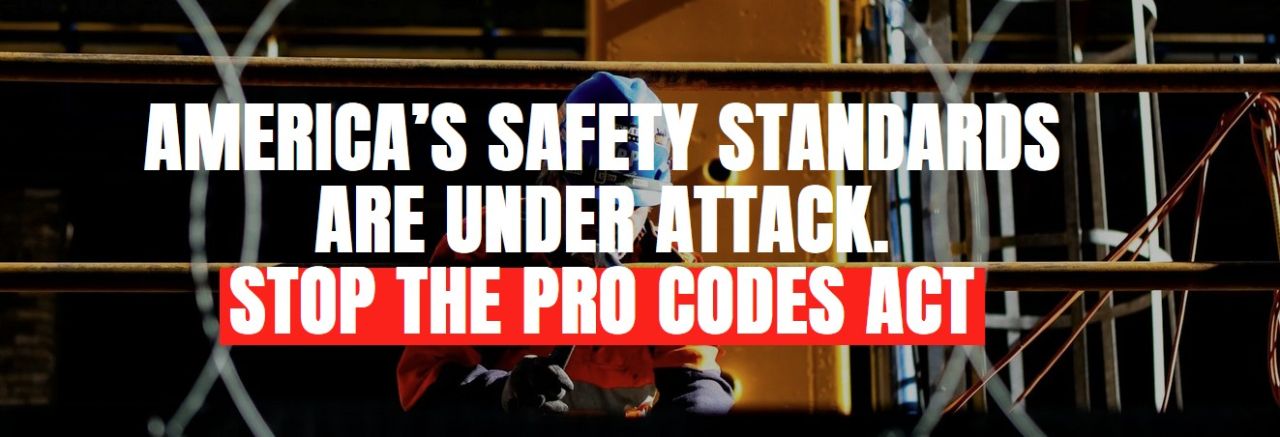
America's Safety Standards Are Under Attack. Stop the Pro Codes Act.
Leaders from ASME, AWS, and others warn the Pro Codes Act could weaken safety standards and threaten U.S. industrial reliability.
AWS strongly opposes the Pro Codes Act because it would fundamentally destabilize and undermine the very system that enables the development of critical safety standards across American industry.”
WASHINGTON, DC, UNITED STATES, April 22, 2026 /EINPresswire.com/ -- Following the House Judiciary Committee’s Subcommittee on Courts, Intellectual Property, and the Internet hearing, “Protecting U.S. Leadership in Codes Development and Enhancing Public Access,” several organizations and experts reiterated their opposition to the Pro Codes Act, warning it would undermine the system that sustains critical safety standards by weakening the copyright protections that fund their development and maintenance.— Carey Chen, AWS Executive Director & CEO
The American Society of Mechanical Engineers (ASME) General Counsel John Delli Venneri testified: “Broadly speaking, our standards help ensure that construction cranes do not collapse, nuclear facilities do not fail, oil and gas pipelines do not rupture, and the turbines used in civilian and defense applications are cutting edge. The Pro Codes Act harms ASME’s copyright, and that of other SDOs, materially—perhaps existentially. It does so by fundamentally reshaping copyright law to benefit a single type of SDO while eroding the copyrights of others. Because of this, nobody should make the blanket statement that this bill is universally ‘good for copyright’ — because it isn’t good for ASME’s copyright or other SDOs like it.”
American Welding Society (AWS) Executive Director and CEO Carey Chen said: “AWS strongly opposes the Pro Codes Act because it would fundamentally destabilize and undermine the very system that enables the development of critical safety standards across American industry. Our mission is to advance the science and application of welding—work that underpins the safety and reliability of countless industrial sectors and the infrastructure Americans depend on every day. Safe welding practices are not optional—they are essential to public safety, national resilience, and economic security. These standards do not emerge by accident—they are built through a rigorous, consensus-driven process led by subject matter experts and sustained through significant investment. Like many smaller SDOs, AWS relies on revenue from standards sales to fund the expert-driven process that develops, updates, and maintains these life-saving standards. By effectively conditioning copyright protection on free public access, the Pro Codes Act threatens this proven model and risks stripping away the necessary resources required to develop, update, and maintain the very standards that protect lives, safeguard infrastructure, and support industry innovation. We urge Congress to reject this legislation.”
SAE International Senior Director of Standards David Alexander said: “The Pro Codes Act is a well-intentioned but misguided proposal that risks undermining the safety, reliability, and security of America’s aerospace and transportation systems—and the manufacturing base that supports them. The mobility industry relies on rigorously developed technical standards to ensure aircraft, cars, trucks, buses and commercial vehicles are designed, built, and maintained to the highest safety thresholds, and these same standards underpin advanced manufacturing and defense programs. By forcing standards organizations to give away their work for free or lose their copyrights, the bill threatens the successful industry-managed model that enables continuous updates and expert oversight. The result would be higher costs to the taxpayer and weaker standards, disrupted supply chains, and an erosion of U.S. innovation and transportation leadership—creating real risks for public safety, national security, and industrial competitiveness.”
International Center for Law & Economics Director of Innovation Policy Kristian Stout said: “Framed as a transparency measure, the Pro Codes Act would in practice upend the economic foundation of standards development. By conditioning copyright protection on government use, it transforms a stable property right into a revocable license—threatening the revenue model that sustains expert-driven standards. In doing so, it ignores critical differences among standards bodies and replaces a nuanced, court-developed balance between access and incentives with a blunt mandate that risks weakening investment, eroding technical quality, and undermining U.S. leadership in global standards-setting.”
The International Institute for Strategic Studies (IISS) Trade and Geopolitics Programme Associate Fellow Michael Schiffer said: “Policy proposals like the Pro Codes Act, however well-intentioned, risk creating strategic vulnerabilities that foreign adversaries are positioned to exploit. If enacted, the bill would destroy the model that funds American leadership in critical infrastructure standards, creating a vacuum that China's state-controlled standards apparatus is designed to fill.”
For more information, visit https://www.stopprocodesact.com/.
Trish Fliss
American Welding Society
tafliss@aws.org
Visit us on social media:
LinkedIn
Instagram
YouTube
Legal Disclaimer:
EIN Presswire provides this news content "as is" without warranty of any kind. We do not accept any responsibility or liability for the accuracy, content, images, videos, licenses, completeness, legality, or reliability of the information contained in this article. If you have any complaints or copyright issues related to this article, kindly contact the author above.
